


PAUL MANAFORT’S NEW LEGAL NIGHTMARE IS EVEN WORSE NEWS FOR TRUMP
The existence of the Rosenstein Memo blows a hole in Manafort’s defense-and sheds new light on the collusion question.
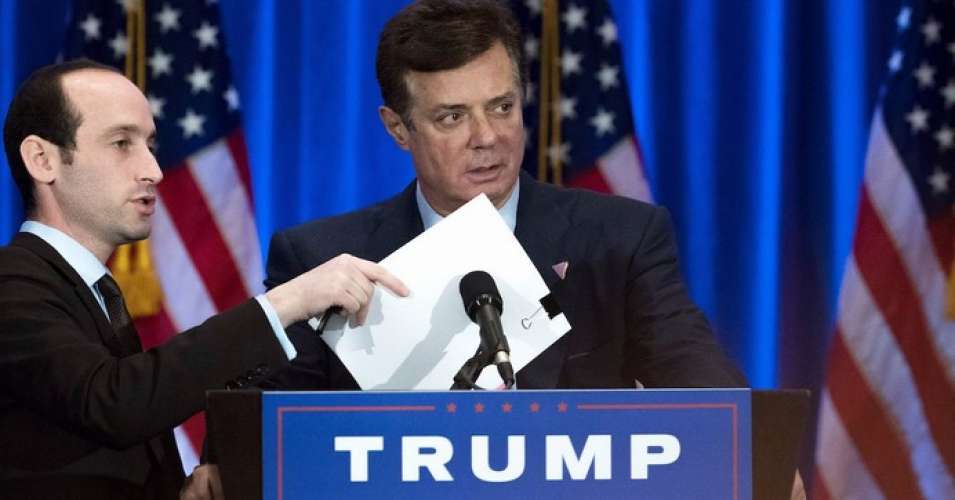
The procedural defense put forward by Paul Manafort, the former Trump campaign manager facing down Robert Mueller, may be fatally flawed. Lawyers for Manafort, who has pleaded not guilty to more than a dozen charges including conspiracy, tax fraud, and lying to the F.B.I., have argued that the allegations are unrelated to the question of collusion, and thus represent an act of overreach by the special counsel.
But that defense crumbled on Tuesday, when it was revealed in a court filing that Deputy Attorney General Rod Rosenstein had authorized Mueller to probe whether Manafort “committed a crime or crimes by colluding with Russian government officials,” according to a previously undisclosed memo.
That document, filed with the D.C. district court on Monday, suggests that Mueller has been seeking to connect Manafort’s work in Ukraine to the Trump campaign all along. Included in the filing is an August 2017 memo from Rosenstein, which says that the scope of the ongoing Justice Department probe included allegations that Manafort “committed a crime or crimes by colluding with Russian government officials with respect to the Russian government’s efforts to interfere with the 2016 election for president of the United States,” and “Committed a crime or crimes arising out of payments he received from the Ukrainian government before and during the tenure of President Viktor Yanukovych.”
The existence of the Rosenstein memo raises several questions about Mueller’s investigation, and how Manafort might fit into the larger issue of Russian collusion.
The filing explicitly states that the special prosecutor’s mandate “would naturally cover ties that a former Trump campaign manager had to Russian associated political operatives, Russian-backed politicians, and Russian oligarchs.” That mandate should cover Yanukovych, who tried to align Kiev with Moscow before fleeing to Russia.
It also presumably includes Manafort’s ties to Oleg Deripaska, the Kremlin-connected billionaire with whom Manafort is reported to have had $60 million in business dealings over the past decade. (During the campaign, Manafort exchanged a series of e-mails with his longtime employee, Konstantin Kilimnik, in which he offered to give Deripaska “private briefings” on the race.
Kilimnik is alleged The Rosenstein memo also gives the special prosecutor the power to “look into any interactions they may have had before and during the campaign to plumb motives and opportunities to coordinate and to expose possible channels for surreptitious communications.
” If Mueller “would naturally follow the money trail from Manafort’s Ukrainian consulting activities,” than any prosecution stemming from that investigation would be “authorized,” too, the filing argues. (Manafort has repeatedly denied colluding with Russians in the 2016 election.)